Represent the interfaces and curved structures that control transport in real nanostructured materials.
Gmsh · FETM · complex nanostructures
Full-3D Geometry in Particle-Transport Monte Carlo
Parametric geometry and meshing workflows that carry real, curved, and layered structures into transport codes originally designed for simple domains.
Goal
Why this problem matters
The research is organised by scientific question rather than career stage, so the methods and results form one continuous programme.
Preserve geometry fidelity so simulated observables correspond to the experimental structure rather than an oversimplified surrogate.
Method
How the problem is approached
- 01
Observe
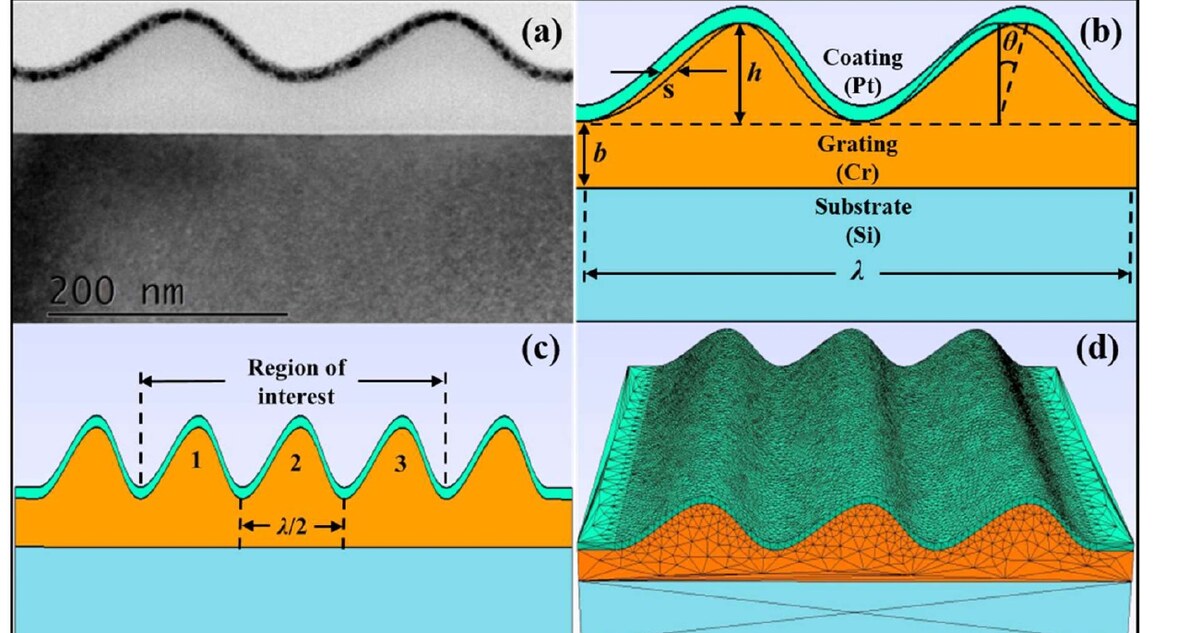
Start from the experimental TEM cross-section of the Pt-coated Cr wave grating on its Si substrate.
- 02
Measure
Extract the wave period (λ/2), peak-to-valley height (h), valley-to-substrate base height (b), linewidth shrinkage (2s), wave-peak tilt (θ), and 10 nm Pt coating into a parameterised material model.
- 03
Construct
Use Gmsh and Python to construct and triangulate the stacked Si, Cr, and conformal Pt regions while assigning every triangle to its material.
- 04
Track
At every facet crossing, query the adjacent triangle or vacuum boundary and switch the electron-transport data to Si, Cr, Pt, or the surface escape rule.
Results
What the programme has established
- Result 01Enabled complex embedded geometry in transport codes previously limited to simple domains.
- Result 02Made triangle ownership and material adjacency explicit, so a trajectory can cross Si–Cr, Cr–Pt, and Pt–vacuum interfaces without losing its physical region.
- Result 03Built reusable pipelines for multilayer, nanoparticle, and superlattice targets while connecting experimental TEM morphology to the transport mesh.
Scientific animation
The mechanism, made visible
This interactive figure is an explanatory schematic. It is clearly separated from the peer-reviewed quantitative figures below.
Conceptual visualization
From TEM morphology to a layered 3D mesh
The actual TEM evidence is converted into measured geometric parameters, a stacked Si–Cr–Pt model, and a triangular mesh whose facets retain material and adjacency information for Monte Carlo transport.
Ready
- Si substrateBottom material region
- Cr gratingWave-shaped structured material
- Pt coatingThin layer following the Cr surface
- Tagged mesh facetStores current and adjacent material regions
- Current stage
- 4 of 4Tagged 3D mesh
- Input
- Validated prior stage
- Output
- Every triangular facet retains material adjacency
- Transport query
- Triangle → adjacent regionSi, Cr, Pt, or vacuum determines the next interaction law
The four visual stages use the supplied 2021 research figure: enlarged TEM cross-section, parameterised Si–Cr–Pt model, five-line simulation region, and 3D mesh. The interface readout explains the material-ownership logic separately.
Evidence
Figures from the research
Each figure is placed beside the scientific programme it supports rather than repeated in a separate gallery.
Publications
Related scholarly work
CD-SEM characterization of smoothly varying wave structures with a Monte Carlo simulation
M. S. S. Khan, L. H. Yang, X. Deng, S. F. Mao, Y. B. Zou, Y. G. Li, H. M. Li, Z. J. Ding
A theoretical characterization method for non-spherical core–shell nanoparticles by XPS
J. M. Gong, M. S. S. Khan, B. Da, H. Yoshikawa, S. Tanuma, Z. J. Ding
Uncertainty evaluation of Monte Carlo simulated line-scan profiles of a critical-dimension SEM (CD-SEM)
M. S. S. Khan, S. F. Mao, Y. B. Zou, Y. G. Li, B. Da, Z. J. Ding