Resolve where energetic ions deposit energy and create primary damage in three-dimensional materials.
3D ion irradiation · primary damage · coupled workflows
IM3D Ion-Irradiation Simulation
Use, documentation, and workflow integration of the parallel IM3D Monte Carlo code for three-dimensional ion-irradiation simulation.
Goal
Why this problem matters
The research is organised by scientific question rather than career stage, so the methods and results form one continuous programme.
Turn primary-damage output into usable inputs for defect-evolution studies and experimental interpretation.
Method
How the problem is approached
- 01
Prepare
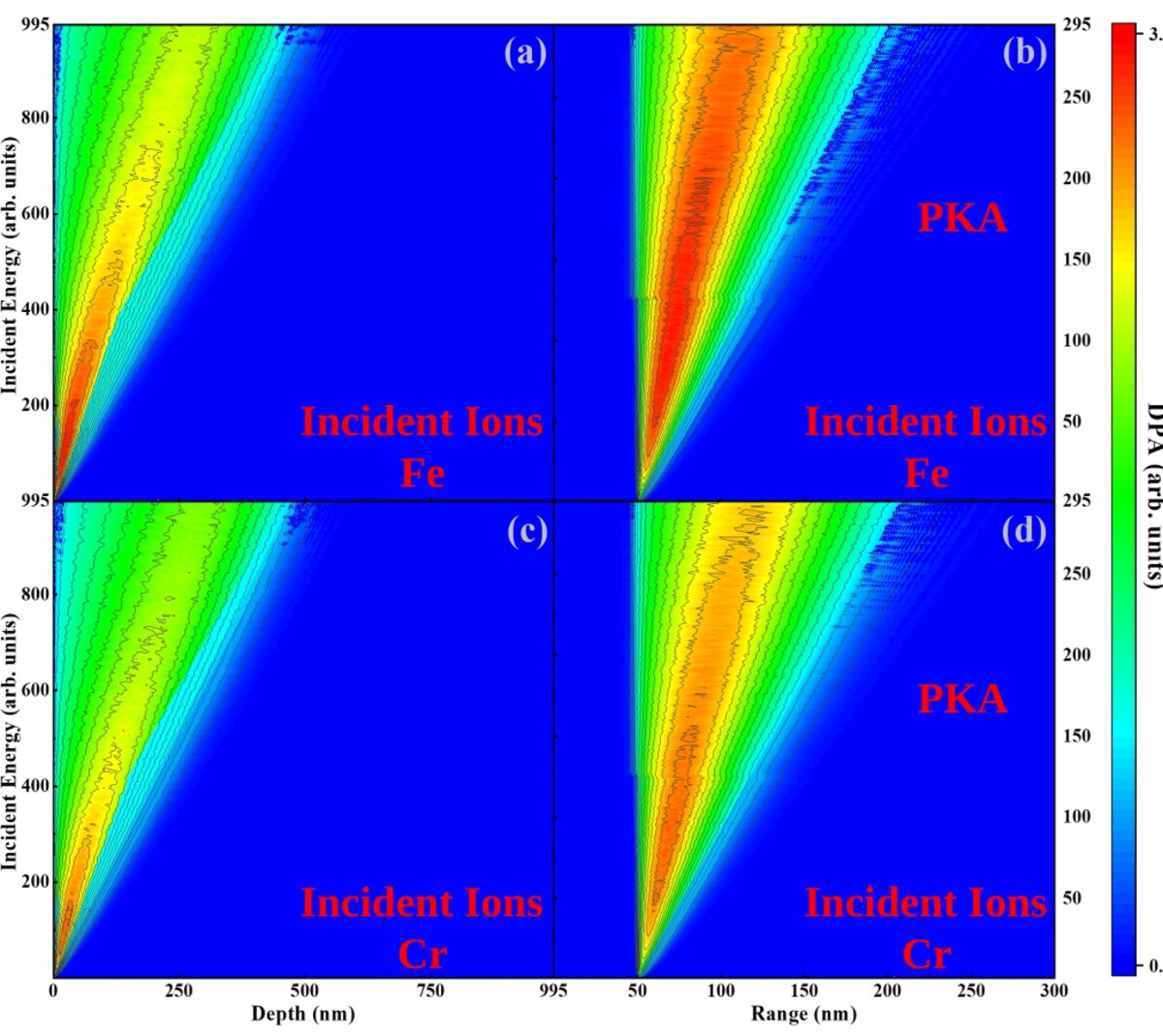
Run IM3D ion and primary-knock-on-atom campaigns across a bulk Fe-Cr target and incident energies.
- 02
Transport
Translate IM3D output into chemical rate-theory and MMonCa workflows for longer-time defect evolution.
- 03
Translate
Document input preparation, output interpretation, and cross-code coupling in reproducible user guides.
Results
What the programme has established
- Result 01Produced an Fe-Cr reference dataset from approximately 1,300 simulations spanning 1,260 incident energies from 0.1 keV to 1 MeV, with 100,000 incident ions per run.
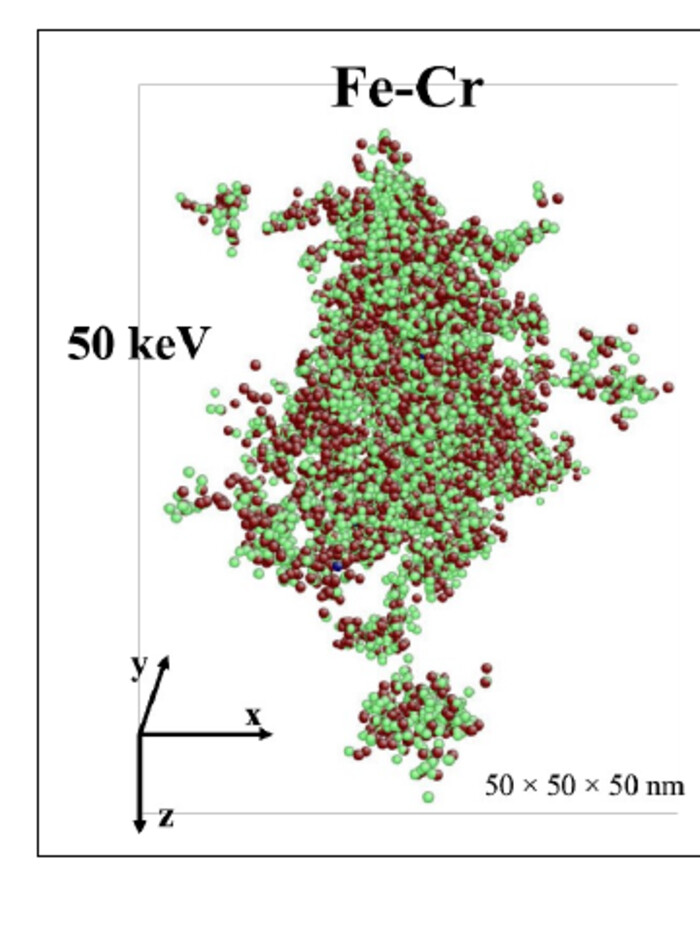
- Result 02Delivered depth-resolved damage profiles, energy-resolved contour maps, and three-dimensional primary-damage distributions to experimental collaborators.
- Result 03Substantially rewrote and restructured the IM3D user manual and received acknowledgment for that contribution in the 2025 manual.
- Result 04Integrated IM3D with a self-developed CRT annealing code and MMonCa for FeNiAl defect-evolution studies.
Scientific animation
The mechanism, made visible
This interactive figure is an explanatory schematic. It is clearly separated from the peer-reviewed quantitative figures below.
Conceptual visualization
From IM3D inputs to radiation-damage outputs
A homogeneous bulk Fe–Cr target and an incident Fe/Cr ion or primary knock-on atom enter IM3D. Binary collisions generate recoil cascades, which are tallied as depth profiles, energy–depth maps, and three-dimensional primary-damage distributions.
Ready
- Bulk Fe / Cr targetHomogeneous material target used in this campaign
- Incident ion / PKA and recoilsBinary-collision paths through the bulk target
- Primary-damage tallyVacancies, interstitials, and DPA accumulated versus depth
- Output fieldsDepth-resolved profiles and damage distributions
- Workflow stage
- 4 of 4Fe–Cr depth maps + 3D damage distribution
- Inputs
- Bulk Fe–Cr + Fe/Cr ion or PKA
- Transport
- Binary-collision Monte Carlo
- Outputs
- Depth profiles · energy maps · 3D damageThe output stages use the supplied Fe–Cr research figures
The workflow is restricted to the supplied bulk Fe–Cr IM3D campaign. Export to CRT or MMonCa is a downstream option and is not shown as part of the Fe–Cr primary-damage calculation.
Evidence
Figures from the research
Each figure is placed beside the scientific programme it supports rather than repeated in a separate gallery.
Funding
Supported research
3D Monte-Carlo simulation of the anti-irradiation effect of superlattice nanoparticle composites
National Natural Science Foundation of China (NSFC)
- Grant
- W2533023
- Funding
- ¥180,000
3D radiation-resistance simulation of superlattice nanocomposites
National Foreign Experts Project (Y Category), State Administration of Foreign Experts Affairs, China
- Grant
- Y20240239
- Funding
- ¥200,000